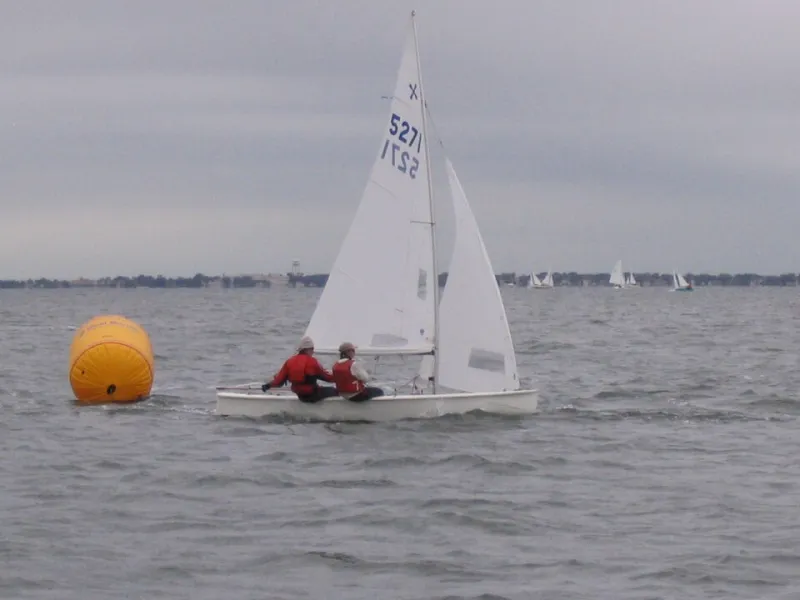
Three Lessons, One Page: The Debrief Habit That Beats Bar-Room Storytelling
Photo: U.S. Navy photo by Petty Officer 2nd Class Henry Liu, Public domain, via Wikimedia Commons
The clubhouse on a November race day has its own rhythm. Boats are on trolleys, sails are half-folded, and someone is already explaining why the right-hand side was a lottery. By the time the first round is on the table, the race has been rewritten three times. The wind was shifty. The start was biased. The committee boat was in the wrong place.
Some of that is useful. Most of it is not. The clubhouse debrief is one of the great traditions of UK sailing, but it is a poor learning tool if it is the only debrief you do.
At Andrew Simpson Sailing, we are interested in the kind of review that changes the next race. That does not require a laptop, a coaching team or a folder full of polar diagrams. It requires a page, a pen and the discipline to be honest before you become social.
The Story We Tell in the Bar
The bar-room version of a race is a story, and stories have heroes, villains and convenient weather. We remember the one shift we missed and forget the three we got right. We explain the bad result with the wind and the good result with skill. It is not lying; it is how memory works when it is warmed by adrenaline and a pint.
The problem is that the story often becomes the debrief. If the only conclusion is that the breeze was unreliable, there is nothing to change. If the only lesson is that the fleet was lucky, there is nothing to test. That is not analysis. It is closure.
Data Is Not the Same as Learning
GPS tracks are brilliant. They can show you a bad lane, a missed shift or a tack that cost you three lengths. But they can also bury you. A club sailor who downloads a track and scrolls through every leg is often more confused at the end than at the beginning.
Campaign sailors use data with a question in mind. They are not asking whether the track is interesting. They are asking whether the start was early enough, whether the first beat matched the plan, or whether a particular mode was faster. Without a question, the data becomes another story.
So before you open the file, decide what you are looking for. If you cannot name it, leave the file alone and write three lines instead.
The Three-Line Rule
One page. Three lines. That is the whole routine.
Line one: what worked? Be specific. Not I felt good, but the port-tack start at the pin gave me a clear lane and I held it for two minutes. Line two: what did not? Again, specific. I overstood the layline on the second beat and lost two boat lengths. Line three: what will I test next time? One thing. One change. One question for the next race day.
This is not a full race review. It is a filter. It forces you to choose the lesson that matters most, and it gives you something to look at before the next start. Three lines are easy to write when you are cold and tired, which means you might actually do it.
Write It Down, Even Badly
A notebook is better than a mental note because the mental note is usually gone by Tuesday. It does not need to be neat. A cheap waterproof notebook lives in the kit bag and survives the winter. Write the date, the wind direction, the course and the three lines. That is enough.
If you sail doublehanded, both of you write a line. Compare them. You will often find that the helm and crew remember different races. That is not a problem; it is useful information. The best debriefs are short conversations with a shared page, not long speeches from the back of the boat.
Debrief With the Crew, Not at Them
It is easy to turn a review into a verdict. The race was lost because someone did not hike hard enough, or because the trim was wrong, or because the start was late. That kind of debrief feels decisive and teaches very little.
Try language that describes rather than judges. I noticed we were slow out of the tack. I thought the wind came left on the second beat. I was unsure about the layline. That opens a conversation. It also makes it easier to hear the answer.
The Clubhouse Can Wait Ten Minutes
The most important part of the routine is timing. Debrief before the bar, not after. Ten minutes, dry clothes, warm drink, notebook. Then go and be social.
This is not a rejection of clubhouse culture. The bar is where you build the friendships that keep you coming back in February. But it is a poor place to make decisions about rig settings, start plans or crew communication. Those decisions need daylight and a clear head.
From Club Racing to Campaign Thinking
The campaign habit at Andrew Simpson Sailing is not complicated. Every race is a chance to learn something, but only if you capture it before the memory softens. The same habit works at a club winter series and at a national circuit event. The scale changes; the principle does not.
A three-line debrief will not make you an instant champion. It will, however, stop you repeating the same mistake for a whole season. It will give you a record of what actually happened, rather than what you remember happening after the third round. And it will make the next race day start with a question instead of a story.
The next time you come ashore, resist the urge to explain the race to anyone who will listen. Get warm. Write three lines. Then go and enjoy the clubhouse. The story can wait; the lesson should not.