The Paperwork Advantage: Five Sailing Instruction Clauses Worth Racing For

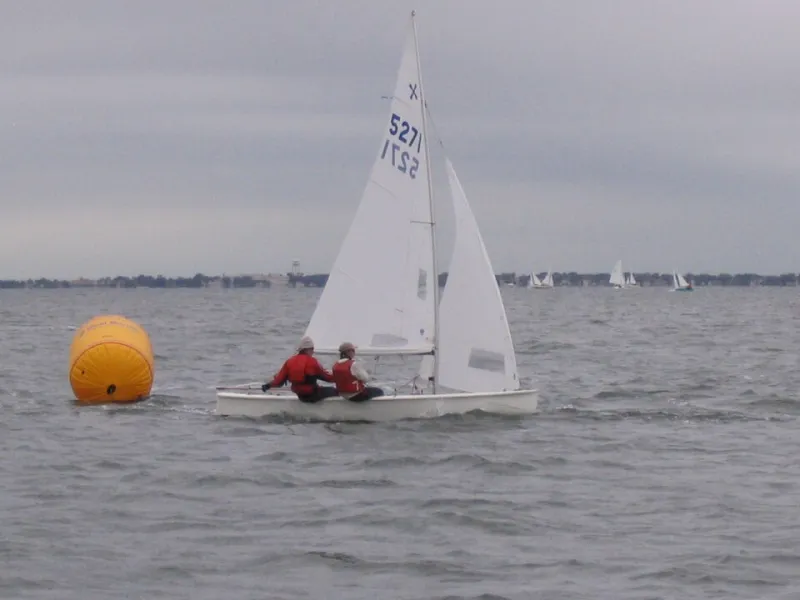
Photo: Indian Navy, GODL-India, via Wikimedia Commons
Two boats leave the slipway with the same wind, the same boat and roughly the same ability. One of them has read the sailing instructions properly. By the first mark, that difference is usually worth several lengths, and by the finish it's often worth a place or two.
The sailing instructions are not administration. They're the rulebook for the specific race you're about to sail, and they override the general prescriptions wherever they say so. Clubs write them for a reason, and the reasons usually involve a local quirk — a harbour wall, a shifting transit, a committee boat that anchors where it can rather than where it would like to.
Here are five clauses worth reading twice, and what each one does to your plan.
One: the definition of the start line
Most sailors carry a mental picture of a line between a committee boat mast and a mark. Plenty of UK clubs don't use that at all. Some set a transit — two fixed objects ashore that you line up — and some use a limit mark with no committee boat in the sequence at all. A few define the outer end as the course side of a particular buoy, which means the line moves subtly with the tide.
Why it matters: an inner-limit or transit line changes which end is favoured and by how much. If the outer end is a fixed object rather than a boat swinging on its anchor, the bias is far more predictable, and you can plan a start approach on the previous leg rather than guessing in the final ninety seconds.
Two: the finish line, and which way you cross it
Almost every set of instructions defines the finish, but the detail is where races are lost. Some specify that you must cross in the direction of the course from the last mark. Some require a particular side of the committee boat. Others say the finish line is between a mast and a mark that isn't the obvious one on the diagram.
Why it matters: an ambiguous mental model of the finish produces the classic error of a boat crossing a line, easing sheets, and then discovering it crossed the wrong one. Read the paragraph the night before and picture it. If the diagram and the text disagree, ask at the briefing — it's a two-minute question that saves a protest hearing.
Three: change of course and the moving mark
Flag C with a numeral pennant, a plus or minus sign, and a new bearing or distance. Or flag S, shorten course, at a mark that isn't the one you assumed. These signals turn a straightforward windward-leeward into something else entirely, and the instructions tell you exactly how they'll be used — including whether the change applies at the next mark or the one after.
Why it matters: if you know the club habitually shortens at a particular mark in a dying breeze, you can position yourself for a finish rather than a beat. In handicap racing on a falling tide, that's the difference between a good result and a long motor home.
Four: time limits and the finishers' window
This is the clause almost nobody reads, and it's the one that most affects the middle of the fleet. Many instructions set a time limit for the first boat, then a separate window — often twenty or thirty minutes — for everyone else to finish after that. Some use average lap times for slower handicap boats.
Why it matters: if you know the window closes quickly, the race becomes about staying in touch rather than taking a flyer on the far side of the course. If average lap racing is in play, the arithmetic changes what a good last lap looks like. Knowing which regime you're in before the gun is worth more than a new jib.
Five: penalties, protests and the arbitration shortcut
Turns penalties, two-turn versus one-turn, and whether the club offers RYA arbitration before a full hearing. The protest time limit is also written down here — commonly ninety minutes after the last boat finishes, occasionally much less.
Why it matters: a one-turn penalty taken promptly is nearly free. The same incident left to a hearing costs an evening, a protest committee's goodwill and, quite often, the result. If arbitration is available, it's usually quicker and softer for everyone. Both facts should be in your head before the start, not dredged up in the bar.
Turning the read into a plan
You don't need to memorise the document. You need a fifteen-minute ritual: read it once for the sequence of the course, once for the limits and penalties, then highlight three things — the start definition, the finish definition, and the time limits. Photograph the page on your phone so it's in the boat with you. Write the three highlights on the club whiteboard or the back of your hand.
That's it. Fifteen minutes, on a Friday evening, with a cup of tea. Over a season it's the best-value preparation most of us will ever do — and it's the same paperwork every competitor already has.