Sparring Partners: Why Every Training Day Should Be a Two-Boat Day
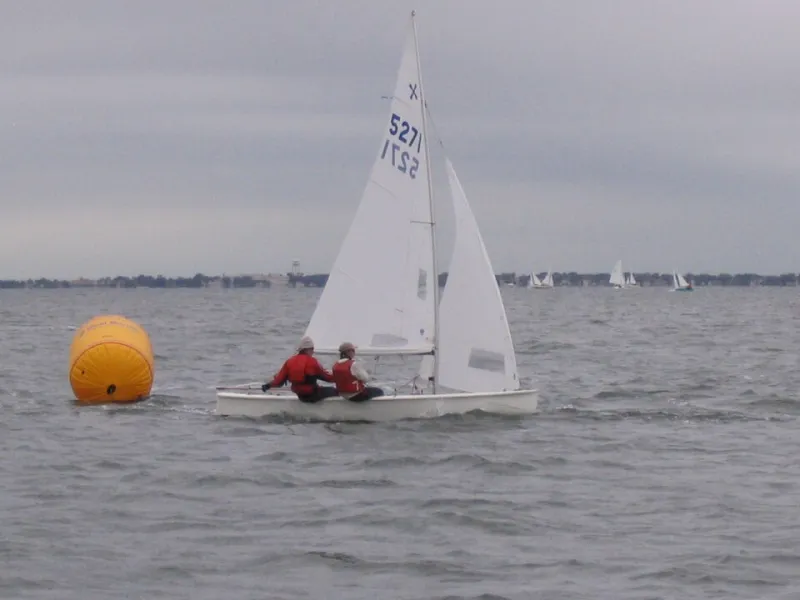
Photo: Maxwell Penders, CC BY-SA 4.0, via Wikimedia Commons
There is a particular kind of loneliness to solo training. You roll out the boat, you do your tacks, you ping a few imaginary start lines, you come in for a brew and you tell yourself it was useful. And it was — up to a point. The trouble is that a boat on its own has no opinion. It will not tell you that you were a second late to the line, that your tack cost you two lengths, or that you left the gate wide open because you were looking at your telltales instead of the boat behind you.
That is the whole case for pair training, and it is why so much of our 2026 campaign was built around being on the water with a second boat rather than chasing numbers on our own. One boat gives you reps. Two boats give you feedback.
What a second boat actually changes
Solo work is brilliant for the mechanical stuff: roll tacks, gybe timing, kite hoists. It is close to useless for the tactical stuff, because tactics need a rival. The moment there is another hull nearby, the drills stop being about the boat and start being about decisions — and decisions are what race days actually test.
The other thing a second boat does is raise the stakes without raising the pressure. Nobody wants to lose a training drill to a mate. That tiny bit of pride is worth more than any coach's stopwatch.
The session shape: ninety minutes, three blocks
We settled on a format that fits into a normal club Sunday: rig by nine, on the water by half nine, off by eleven. Two boats, one coach or a friend on the RIB with a flag and a whistle, and a single inflatable mark. Rotate roles every block so nobody spends the whole morning as the punchbag.
Block one — start-line timing (0 to 25 minutes)
Pick a transit on shore that you can see from both ends of the line, set a pin buoy, and run four-minute sequences. Boat A starts as the subject and calls the sequence; Boat B sits half a length to windward and simply races.
- Run one: both boats start normally. No talking afterwards for thirty seconds — just look at where you each were at the gun.
- Run two: Boat B deliberately starts a second late. Boat A has to hold station without being pushed over.
- Run three: Boat B deliberately starts a second early. Boat A has to watch and react, not just sail its own plan.
- Run four: swap roles.
The gain here is not the perfect start. It is learning what an early start looks like from the boat next door, because that is the only view you get on race day. By the end of the block, both crews should be able to call the gun within half a second without a watch.
Block two — the tacking duel (25 to 55 minutes)
Set a windward mark, start together, and give the leeward boat the right to tack whenever it likes. The windward boat's only job is to hold its lane and not be rolled. Then swap.
Three rules keep this honest. First, no luffing above close-hauled — a training duel that turns into a scrap teaches nothing. Second, the trailing boat calls the tack out loud, so both crews are practising a real race habit. Third, if a boat loses two lengths, reset and go again rather than grinding out a lost cause.
What we noticed through 2026 was that most of the losses in this drill came from the tack itself, not the decision to tack. The call was usually right; the exit was slow. That is a much easier thing to fix once you have watched it happen six times in a row.
Block three — mark-rounding pressure (55 to 85 minutes)
This is the block that pays for the whole morning. Set a reaching mark or a leeward gate, send both boats in on opposite tacks, and make the inside boat's life difficult — legally, but genuinely difficult.
Give the outside boat one instruction: get to the mark with speed and a clear lane, or bail out and take the other gate. Give the inside boat another: hold your overlap and your exit.
The first few attempts are usually chaos. Somebody overstands, somebody stalls in the luff, and the whole thing ends with a conversation about rights. Keep going. By the fifth attempt, the roundings become calm, and calm roundings in training are worth a lot in a crowded fleet on a Saturday.
What 2026 taught us
Three things stuck. The first is that pair training exposed habits we would never have found alone — a tendency to sit too long on starboard at the pin, and a real reluctance to bail out of a bad mark approach. The second is that the drills transferred almost directly: at a breezy open in the spring, the mark-rounding confidence from those sessions showed up as two clean leeward-gate exits we would previously have bodged. The third is more mundane — the debrief afterwards got shorter and sharper, because both crews had seen the same thing at the same time.
The club version
You do not need a coach, a RIB or a committee boat. You need two boats of broadly similar speed, one buoy, a tide table so you know what the water is doing, and a willingness to stop racing and start resetting.
Our advice to anyone trying it for the first time: keep the blocks tight, keep the rules simple, and always finish with two straight windward-leewards where nobody is allowed to talk about the drills until the boats are back on the trolley. Training that ends in a race is training people actually turn up for.
And if you only ever do one thing with a second boat, make it the mark roundings. Starts get the glory, but roundings get the results.