The Pin Is Not a Prize: Rethinking Light-Wind Starts on UK Race Courses

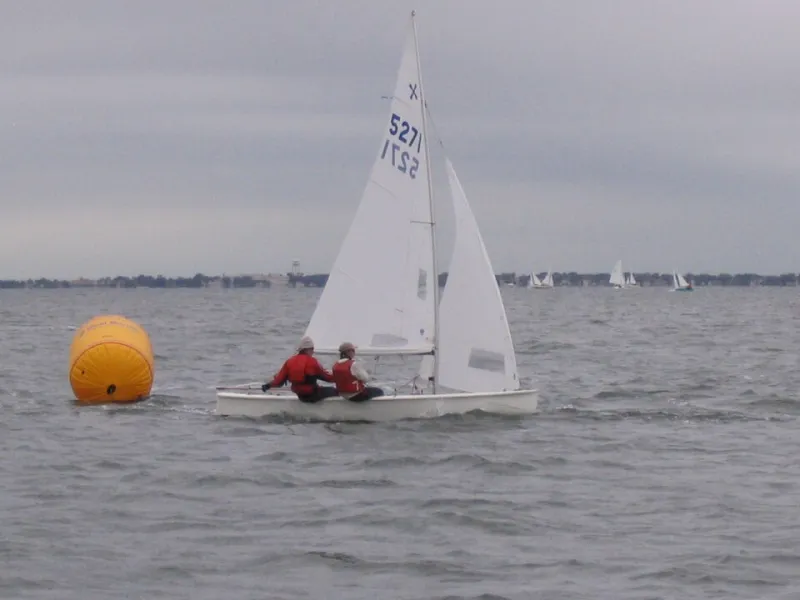
Photo: Pedro Ribeiro Simões from Lisboa, Portugal, CC BY 2.0, via Wikimedia Commons
Light-air starts on UK race courses have a habit of looking decisive and being anything but. The gun goes, half the fleet has already committed to the pin, and five minutes later the same boats are parked in a bad lane with dirty air and no obvious way out. We have watched this pattern at club level and at open meetings through the 2026 season. The problem is not that sailors lack speed in light winds. It is that they treat the start as a sprint to the favoured end rather than a short tactical problem.
The pin is not a prize
A pin-end start looks brave. It is easy to photograph and easy to talk about in the bar. But in light air, the pin is only valuable if the line bias, the tide and the first shift all agree. On many UK inland courses the wind is shifting through ten or fifteen degrees before the start. On coastal courses the tide can make one end look shorter while pushing you sideways. Committing early to the pin removes your options. You arrive in a crowd, you lose clear air, and you spend the first beat trying to recover.
Tide, line bias and the illusion of the shortest path
Line bias is not just a transit on the committee boat. It is a conversation between the wind, the tide and the angle you can hold. At a coastal club with a cross-tide, the pin may be geometrically closer but tactically slower. At an inland reservoir, the committee boat end may look square until a shift makes the pin a trap. The fix is simple: check the line early, check it again, and ask what the tide is doing to the first hundred metres. If you cannot explain the bias in one sentence, you do not have a plan.
Clear air is a tactical position
In light air, clear air is not a consolation prize. It is the position that lets you sail your own race. A second-row start with clean air and a lane to the first shift is often better than a first-row start in a stack. We saw this repeatedly in 2026: boats that started mid-line, slightly late, with speed and clear air, rolled past the pin-end group on the first beat. The lesson is not to start conservatively every time. It is to protect the one thing you cannot buy back after the gun.
A calmer starting routine
Our training notes for light-air starts now use a three-stage routine. At three minutes, identify the bias and the tide. At two minutes, choose a lane and an escape route. At one minute, execute with speed and no last-second changes. The routine is deliberately boring. Boring starts are easier to repeat.
Drills for shifty UK conditions
First, the transit drill: set a transit on the line and check it from both ends. Second, the ninety-second runway: practise approaching the line with time to accelerate, not with a rush. Third, the no-go pin drill: deliberately start away from the pin and debrief whether the clear air was worth it. Fourth, the shift log: note the first shift after the start and compare it with your plan. These drills do not need a coach on the water. They need a notebook and the discipline to review.
What to change before spring
The winter is the right time to rebuild the habit. Practise start sequences on a small course, review the tracks, and write down the line bias and tide for your regular venue. When the 2027 season begins, the goal is not to win the pin. The goal is to leave the line with options. That is a calmer, faster way to start in light air.