The Observer's Advantage: Five Start-Line Truths from the Committee Boat
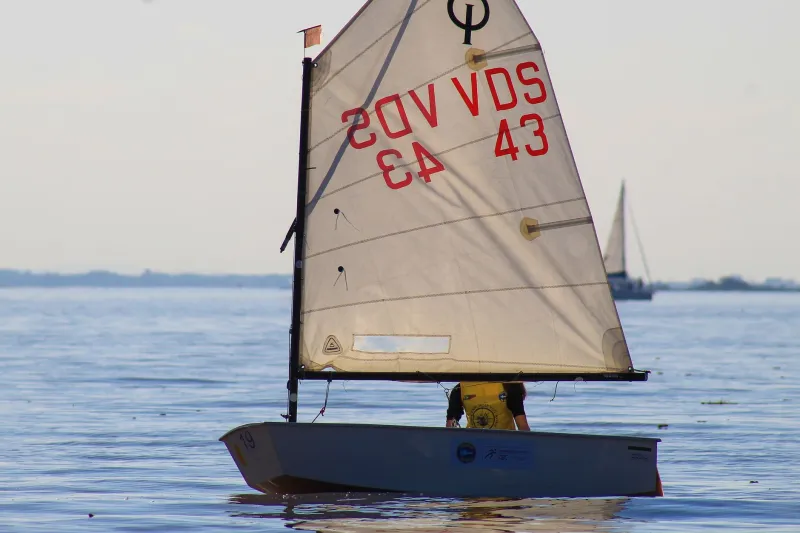
We spend most starts looking forward from our own bow: the pin, the committee boat, the first mark, the space we want and the boats we would rather avoid. But the committee boat is looking back at us, and after a few conversations with UK race officers and safety-boat crews, it becomes clear that they see a different race entirely.
Not a more judgemental race — although there is some of that — but a more pattern-based one. They see the line as a moving thing, the fleet as a series of decisions, and the final minute as a sequence rather than a scrum. The useful part for sailors is that their view is not secret. It is just unfamiliar.
Truth one: the line is a moving target, not a painted stripe
From the committee boat, the start line is rarely the neat geometric line we imagine from the dinghy park. Wind shifts, tide, an anchored committee boat swinging on its rode and a pin buoy dragging gently downwind all change the picture. A line that was pin-biased five minutes ago can be boat-biased by the gun, and the race officer can see it happening.
That is why the best pre-start habit is not to take one transit and treat it like scripture. Check the bias early, then again with three minutes to go, then once more in the last sixty seconds. On a shifty reservoir or an estuary with tide running across the line, the change can be quick enough to punish a boat that committed too soon. The committee boat sees the whole line; you only see your end. Borrow their perspective by looking up and down the line, not just at your own bow.
Truth two: late arrivals are loud, quiet errors are costlier
A boat arriving at the committee boat end with two minutes to go is obvious from the deck. Sails flapping, crew shouting, a rushed tack into a gap that was never really there. Race officers notice it because it disrupts the line and because it often ends in an individual recall or a black-flag exit.
But the quieter mistake is the one that happens earlier. A boat that drifts down the line on starboard, loses its transom and then tries to salvage a lane by luffing up into bad air. From the committee boat, it looks less like a racing incident and more like a decision made too late. The safety crew often see the consequence first: two boats close enough for a hail, one of them already out of the mode it wanted.
The lesson is not to arrive early for the sake of it. It is to decide early. Pick your end, your lane and your bail-out. If the gap is not there with ninety seconds to go, take the second-best option rather than the heroic one.
Truth three: flag timing is a sequence, not a single moment
Sailors tend to watch the countdown on a watch, then look up for the gun. Race officers watch a sequence. Warning, preparatory, one-minute, start — flags, sounds, timing and the behaviour of the fleet all fold into one picture. They can see who is already over, who is late to the line, and who is treating the sound signal as a suggestion rather than the final act.
The quiet error here is anticipation. A boat that starts on the hooter before the flag has settled, or one that assumes a general recall because the fleet looks ugly, gives away control. The committee boat sees the same thing you do, but from the outside. If the line is crowded and the flag sequence is tight, the safest habit is to watch the flag and trust the sequence, not the noise around you.
Truth four: the pin end has a personality
Every start line has a character. The pin end might be biased, crowded, tide-affected or simply fashionable. From the committee boat, you can see the fleet bunching there long before the gun, and you can see the boats that have committed to a port-tack flyer without a clear lane home.
The safety boat sees the other side of that personality: the near misses, the late tacks and the boats that discover the pin is not actually a prize. A pin-end start can be excellent, but it is not automatically brave. If the bias is modest and the traffic is heavy, the committee boat view suggests the middle or the boat end may offer a cleaner lane and a calmer first two minutes.
Truth five: the first beat is already visible before the gun
Once the gun goes, the committee boat does not stop watching. They see who has clear air, who is locked into a bad lane and who is already hiking hard on the wrong side of the first shift. Safety crews see the same thing from water level, which is why their post-race comments often sound more tactical than sailors expect.
The quiet mistake is starting in bad air and hoping it will sort itself out. It rarely does. If you can see the committee boat flag but not the gap you wanted, the first beat has already told you something. Clear air and a simple lane beat a perfect-looking start that leaves you gasping in someone else's dirt.
Build your own committee-eye routine
You do not need to be a race officer to borrow their view. Ten minutes before the start, look at the line from both ends and note the bias. Five minutes out, identify two escape lanes. Three minutes out, check the transit again. One minute out, watch the flags and listen for the sequence. After the gun, look for clear air before you look for the perfect shift.
It is a slightly humbling exercise. The committee boat sees the start as a whole, and most of us see it as a personal argument with the pin. But that is the point. The more you can imagine the view from the far side of the gun, the fewer surprises you leave on the line.